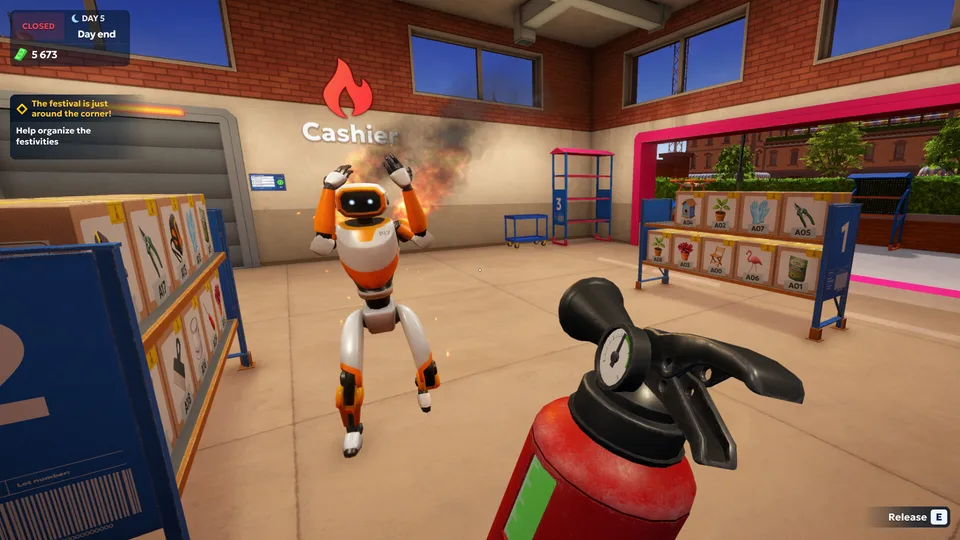
Explore the shipping store simulator 2037 indie game showcase featuring Playstrom's logistics management, automated robotics, and futuristic delivery.
Published: Shipping Store Simulator 2037 Wiki Editorial Team
Table of Contents
Stepping Into the Future of Logistics
Logistics management has just taken a wildly chaotic and futuristic leap with the official release of Playstrom’s latest creation, making waves in any modern shipping store simulator 2037 indie game showcase. If you have ever wondered what running a bankrupt delivery service in the year 2037 actually feels like, this immersive simulation title answers that question with towering stacks of packages and hyper-efficient robotic assistants. Understanding how to scale your humble warehouse into a sprawling cosmic distribution hub is essential for mastering the competitive economy of Cranelock.
For simulation enthusiasts tracking the shipping store simulator 2037 indie game showcase, the transition from manual labor to automated empire building forms the heartbeat of the gameplay loop. According to community reports and developer diaries published around the October 14, 2026 launch, balancing early-game manual sorting with advanced 24/7 robotics dictates your ultimate financial survival.
Tip
Early Game Strategy: Spend your first few hours personally managing high-priority deliveries before investing heavily in automated warehouse units to prevent costly bottlenecks.
Core Gameplay Mechanics and Progression
Managing an abandoned warehouse requires more than just tossing boxes onto a shelf. The progression curve scales dynamically as players unlock sophisticated delivery vehicles and tackle high-stakes corporate espionage. The following table breaks down the key operational tiers available in the game:
Progression Tier
Primary Tool / Vehicle
Operational Focus
Risk Factor
Manual Phase
Human Labor & Hands
Initial sorting, basic customer service
High fatigue, slow volume
Automation Phase
24/7 Warehouse Robots
Continuous processing, inventory flow
Maintenance management
Transit Phase
Delivery Vans & Drones
Ground and aerial order fulfillment
Traffic and routing efficiency
Cosmic Phase
Custom Rocket Ships
Interplanetary and orbital logistics
High capital investment
Player experience shared across community hubs indicates that maintaining a steady cash flow depends on balancing legitimate storefront advertising with clandestine black-market operations. Competitors will utilize dirty tricks, requiring managers to deploy aggressive marketing campaigns and secure VIP contracts under the cover of night.
Automation and Robotic Workforce Management
Once your warehouse begins generating surplus income, manual intervention quickly becomes obsolete. Transitioning to a fully automated workforce transforms the game from a frantic time-management puzzle into a strategic optimization challenge.
Ground Robots
Ideal for constant indoor sorting and moving packages between storage bays and loading docks without human fatigue.
Delivery Drones
Perfect for urgent, time-sensitive urban deliveries that bypass standard ground traffic limitations in Cranelock.
Rocket Infrastructure
The ultimate late-game investment designed to push your shipping volume past Earth's atmosphere for cosmic-scale clients.
Analyzing your facility's daily throughput helps determine precisely when to upgrade your robotic fleet. Community reports emphasize that ignoring bot maintenance or failing to match robot models to specific warehouse zones will lead to severe operational gridlock.
System Requirements and Technical Performance
Running a futuristic logistics empire demands a capable rig, especially when the warehouse expands to accommodate hundreds of automated units and bustling city traffic. Ensuring your hardware meets the developer's specifications guarantees a smooth simulation experience.
Verify Operating System: Confirm your PC runs Windows 10 (64-bit) or higher.
Check Processor and RAM: Ensure you have at least an Intel i5 3550 paired with 8 GB RAM (16 GB recommended).
Review Graphics Hardware: Equip an NVIDIA GTX 1050 minimum, or upgrade to an NVIDIA GTX 2070 for optimal recommended visual fidelity.
Allocate Storage: Free up 7 GB of available disk space for the installation files.
Player feedback regarding optimization has been overwhelmingly favorable, contributing to the title's "Very Positive" Steam rating during its launch window.
Frequently Asked Questions
What is the main objective of Shipping Store Simulator 2037?
Players manage a bankrupt delivery warehouse in the year 2037, progressing from manual package sorting to automating operations with robots, drones, and delivery rockets.
When was Shipping Store Simulator 2037 released?
The game officially launched on Steam on October 14, 2026, developed by Playstrom and published by SayGames.
How does the shipping store simulator 2037 indie game showcase highlight features?
Showcases and developer diaries focus heavily on the rebuilding of Cranelock, the implementation of 24/7 automation, and balancing legal advertising with black-market VIP contracts.
What are the minimum PC requirements for the game?
You need a 64-bit Windows 10 OS, an Intel i5 3550 or AMD Ryzen 5 2500X processor, 8 GB of RAM, and an NVIDIA GTX 1050 or AMD R9 270X graphics card.